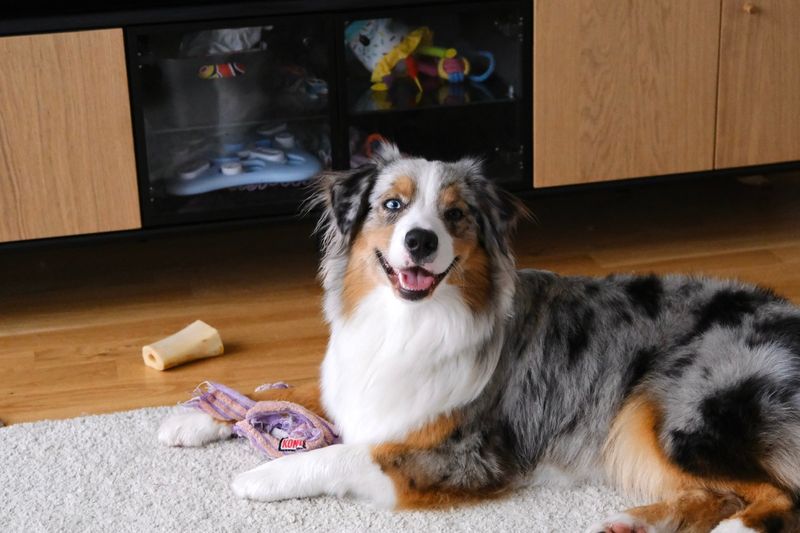
I blinked and Abby went from 4kg to 17kg. A year has passed. Where did all the time go?
I wanted to document our first year honestly, and I hope that by sharing our experience it can help future dog owners know what to expect.
Before we got Abby, we did a lot of research about the Australian Shepherd temperament and thought we were ready. Multiple articles warned us that this breed is not ideal for first time dog owners. That advice flew right over our heads and here we are.
TLDR: You can absolutely have an Aussie as your first dog, but only if you are a responsible owner who is truly committed to showing up for them unconditionally.
Every dog is unique. Here is our first year with Abby.
The Puppy Blues, 8 to 12 Weeks
Before picking Abby up at 8 weeks, we had watched countless YouTube videos of puppies sleeping peacefully through the entire car ride to their new home. Not ours. Abby cried and screamed the whole way back, making it very clear she was not happy about being kidnapped. Her first sign of personality, and her sensitivity, was already showing.
The first two weeks were rough. Abby was incredibly fearful and we later learned she was likely going through her first fear period. On top of that, there were a few pee accidents every day while we were both still learning to read each other's cues. It was mentally and physically exhausting.
This is apparently known as the puppy blues. At this stage it is completely normal to question your decision and wonder what you have gotten yourself into. It will pass and it will get better. Trust me.
To keep ourselves sane, we were very strict about enforcing nap times and made sure Abby was sleeping at least 18 hours a day. She stayed in her own playpen for both naps and overnight sleep. We did sleep in the living room with her the first few nights, but eventually moved back to our room. Luckily she settled quickly and did not whine much through the night.
Vet visits for her first vaccines were not fun. Abby was extremely dramatic about needles, but we got through it and eventually started venturing out more to socialise her.
One last thing worth mentioning. Every video online makes teaching a puppy to sit look effortless. It took us a full week. Do not be discouraged if your puppy does not learn as fast as the ones you see online.
The Cute Puppy Phase, 3 to 6 Months
By week 12, Abby was quite good at holding her pee and letting us know when she needed to go. Supervision was still needed but we were seeing real progress.
This was also the phase where I started to feel like she was truly my dog. The connection between us was getting stronger and it no longer felt like I was caring for a stranger.
We enrolled Abby in puppy school around this time, attending every week. It gave us a structured environment to practice recall and other skills which we highly recommend for any new dog owner. Living in Geneva, we also started introducing her to public transport, trains, trams, buses and even ferries. Watching her confidence grow in new environments was really rewarding.
Her command vocabulary was expanding too. Sit, down, recall, bang, spin. You could actually see her brain working and feel yourself becoming a more confident owner alongside her.
Energy levels were still manageable at this stage, but the major downside was teething. Abby would bite us regularly and our clothes paid the price. Our jeans had holes, my husband's Patagonia down jacket got punctured too, though thankfully Patagonia was able to repair it. Our advice is to wear clothes you do not mind sacrificing during this phase.
On exercise, the common recommendation online is 5 minutes of walking per month of age. We did not follow this strictly. There were days we walked for an hour at Abby's pace and she was fine. The key is to never force your dog to keep going if they seem tired, and to avoid jumping which puts unnecessary strain on developing joints.
The Teenage Phase, 6 to 12 Months
I call this phase adult body, puppy brain. They look all grown up but they are still very much a puppy underneath.
One of the biggest challenges during this phase was that Abby became extremely picky with her kibble. We had to try the starve her out method more than once, and even then she would not always finish her bowl. Looking back we are still not entirely sure how we got through it, but we persevered and her appetite came back after she turned one.
We also started giving her more freedom and trust at this stage. We began off leashing her more often and kept practicing recall in stable environments to build reliability. We would strongly recommend starting this early. If you wait too long you may never feel confident enough to give your dog the freedom to run freely, and that freedom matters a lot for a high energy breed like an Aussie.
Abby was not particularly naughty during this phase. She never destroyed our furniture which we are very grateful for. For exercise, about one to two hours of off leash activity a day was enough to keep her satisfied and calm at home.
Her true personality really started showing though. Abby is extremely sensitive. She barks at noises outside the apartment, watches TV and reacts to unusual sounds or animals on screen, and if someone is walking strangely or wearing unusual clothing outside she will bark at them too. We tried many methods to address this and honestly nothing has fully worked. What helps now is that I know her well enough to anticipate what might trigger her, and if I warn her in advance she tends to stay calm. But if I miss a cue, she will still bark.
Abby's first heat came quite late. The main inconvenience was that exercise became tricky since she was not allowed off leash in most parks, and with many male dogs keen to sniff her, she eventually started growling to communicate her discomfort whenever they got too close.
What Nobody Tells You About Aussies
Most people know that Aussies are velcro dogs, meaning they stick to their pack and follow you everywhere. The upside of this is that recall is generally easier to train compared to other breeds since they naturally want to stay close to you. The downside is that they will pick a favorite. Having an Aussie as a couple is not for the faint of heart. Do not be jealous if it is not you.
The herding instinct is also very real, even if it is not as intense as a Border Collie. It helps to understand that Aussies herd through nipping, barking, and body slamming, which according to Google is classified as a forceful herding style. Knowing this helps you make sense of their behavior when you see it in action. So far Abby has tried to herd running kids, fast cyclists, joggers, and kids on scooters. We have worked on most of these triggers and about 90% of the time she can ignore them, but it is instinct and I do not believe it is something they can ever fully switch off.
Our approach is to warn her in advance when we spot a trigger coming. Off leash this works well. On leash we slow down or stop to create distance, and if we miss it we let her bark it out since she cannot get to the trigger anyway. Once it passes she settles immediately.
Aussies are also incredibly vocal and can make a wide range of sounds which is honestly very cute. The barking on the other hand is a lot. There is no way to sugar coat it. We have just learned to live with it, avoid situations that we know will set her off, and accept that it is part of who she is. To be fair she is getting better, just at a very slow pace.
What We Would Do Differently
If I could go back, I would hire a professional trainer earlier. Puppy school is great but you are sharing the trainer's attention with a whole class, which makes it hard to go deep on specific issues that are unique to your dog.
If you are raising a puppy with a partner, being on the same page about training is also really important. Inconsistency between the two of you can slow progress significantly.
On timing, do not wait until a problem has already progressed too far before calling a trainer. We were lucky that Abby's behaviors never escalated to a serious level, but looking back I still believe she could have benefited from more targeted one on one guidance early on.
Final Thoughts
When I look at Abby now, it is hard to believe how much we have been through together in just one year. She has gained so much confidence and I am incredibly proud of the progress she has made.
Despite her shortcomings, I would absolutely get an Aussie again. I understand the breed so much better now and honestly their loyalty is something else. We truly do not deserve them.